
Ayodhya to Chitrakoot
Onward Journey - 49

Did Ram have an Itinerary?
When the young prince Ram set off on his fourteen-year vanvaas—his exile into the forests—did he have a plan? A route map? A list of destinations to pause and rest?
I’ve often wondered about that.
As a child reading the Ramayana, I was struck not just by the heartbreak of separation or the weight of royal promises, but by something more mundane and quietly unsettling—what happens next, logistically? When King Dasharath, bound by a fateful promise to Queen Kaikeyi, asked Ram to leave the palace just before his coronation, did the prince have any idea where he would go the very next morning?
There was no time to prepare, no court advisors to chart the route, no royal entourage with tents and supplies. Everything changed overnight. One moment he was Ayodhya’s heir, the next—a wandering exile accompanied by his wife Sita and brother Lakshman.
To me, this part of the Ramayana reads not just like an epic of dharma, but also a travelogue—albeit an unplanned one.
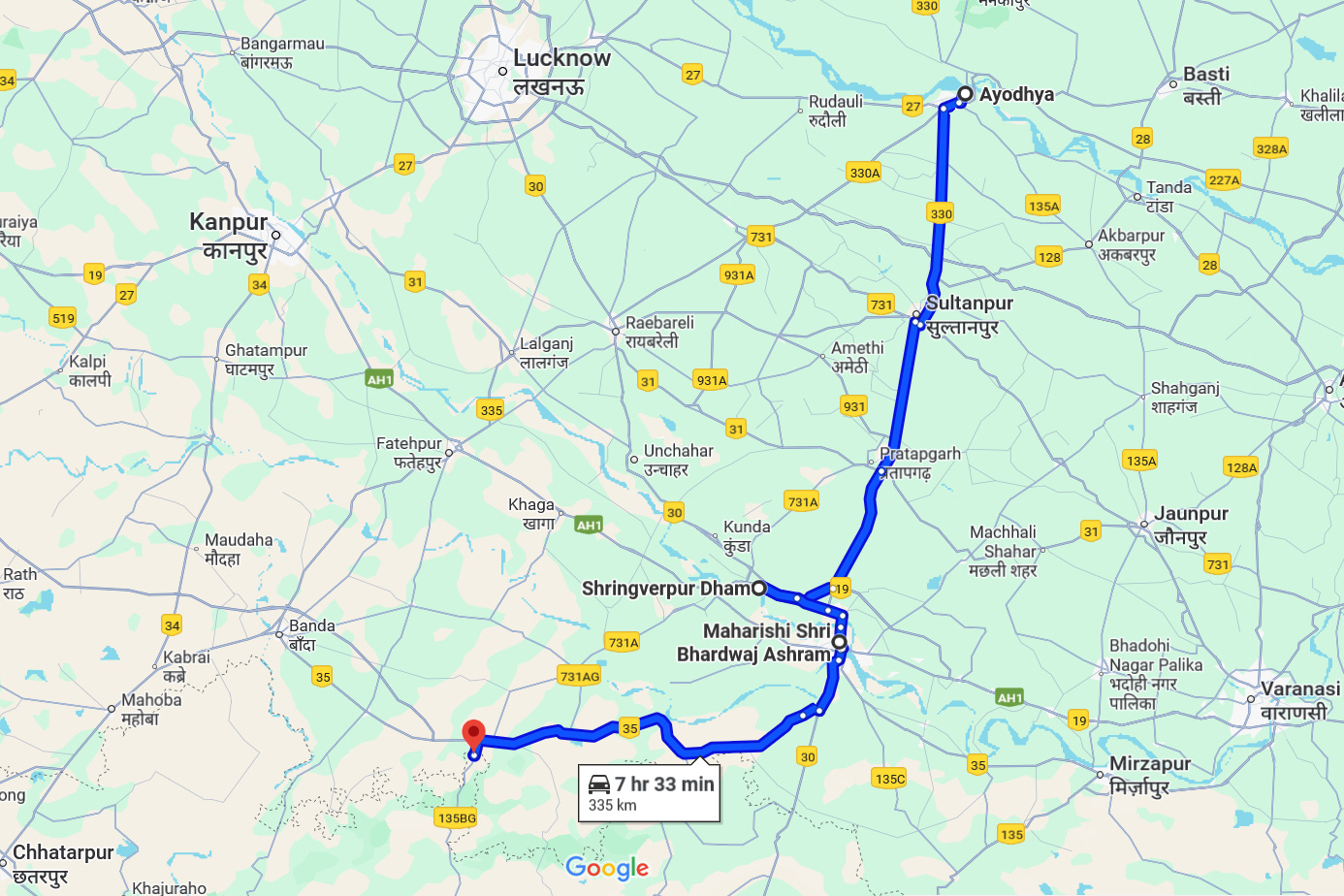
Ayodhya to Chitrakoot Route
In this edition of the newsletter, I won’t go into the many dramatic turns of the exile. Instead, I will trace the first half of this journey—up to the moment when Sita is taken away, and the exile turns into a mission.
Over the coming weeks, I’ll be sharing stories and travel itineraries of places that lie along this sacred trail—sites that have, over time, transformed from way points in an ancient epic to living pilgrim towns with layered histories and unique local cultures.
Whether you’re familiar with the Ramayana or discovering it for the first time, I hope you’ll join me on this holy trail—part legend, part landscape, and entirely timeless.
In the Footsteps of Ram: From Ayodhya to Chitrakoot
We begin, naturally, at the point of departure: Ayodhya, the city of kings and gods, and follow his footsteps till Chitrakoot, the forested refuge where the exiled prince first found peace—and perhaps acceptance of his fate.
1. Ayodhya: The Beginning of Exile
The story begins in Ayodhya, once the glittering capital of Kosala, where this place of celebration turned into a scene of silence and tears, many yugas back (Treta Yuga).
The people of Ayodhya wept; some followed him for miles. Even the river Tamasa, where he paused on the first night, became a silent witness to sacrifice.
Travel Tip:
I have shared itinerary here – Ayodhya Itinerary
Ram Janmabhoomi Complex (historic and symbolic heart of the city)
Kanak Bhawan, believed to have been gifted to Sita
Guptar Ghat, associated with Ram’s later life and departure from earth
Nearby: Tamasa River banks for a less-crowded, contemplative experience
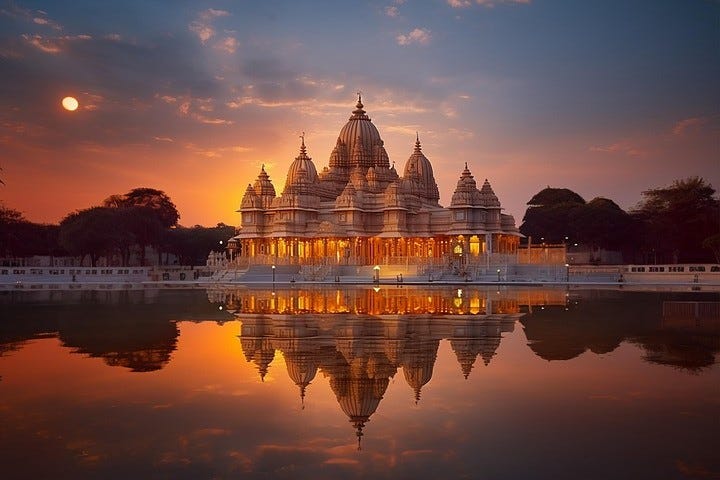
AI generated Ayodhya image
2. Shringverpur
Shringverpur- located little north of modern-day Prayagraj is where Ram crossed the Ganga. It was here he met the boatman Kevat, who insisted on washing Ram’s feet before letting him step into his boat. Shringverpur is a quiet village today but still holds a modest temple and local stories. A visit here is more about listening to the land than sightseeing.
Check out this itinerary of Shakti Peeths in Prayagraj
3. Bharadwaj Ashram in Prayagraj
Further south, the trio reached the ashram of Rishi Bharadwaj near Prayagraj, at the confluence of the Ganga, Yamuna, and Saraswati. Here, Ram was advised to journey to Chitrakoot.
Don’t Miss:
Bharadwaj Ashram, still a functioning pilgrimage spot
Nearby: Triveni Sangam, Prayagraj Fort (built by Akbar), and Anand Bhavan for a historical detour
4. Chitrakoot
Set against the Vindhya hills, Chitrakoot is where Ram, Sita, and Lakshman built their first home in exile. Bharat came here searching for Ram, begging him to return to Ayodhya. Ram declined—but gave him his sandals (paduka) to place on the throne as a symbol of rightful rule.
What to See in Chitrakoot:
Ramghat on the Mandakini River
Kamadgiri Hill, considered the heart of Chitrakoot
Bharat Milap Temple, where the brothers reunited
Gupt Godavari, a set of sacred caves believed to be the place where Ram, Sita and Lakshman lived.
Travel Notes:
Chitrakoot lies on the Uttar Pradesh–Madhya Pradesh border. The town is best visited in cooler months (October to March). Despite modest infrastructure, the town retains a deep spiritual charm.
Final words…
From palaces to forests, from royal declarations to river crossings—this first stretch of Ram’s journey marks a quiet transformation. A prince became a wanderer, a warrior-in-waiting.
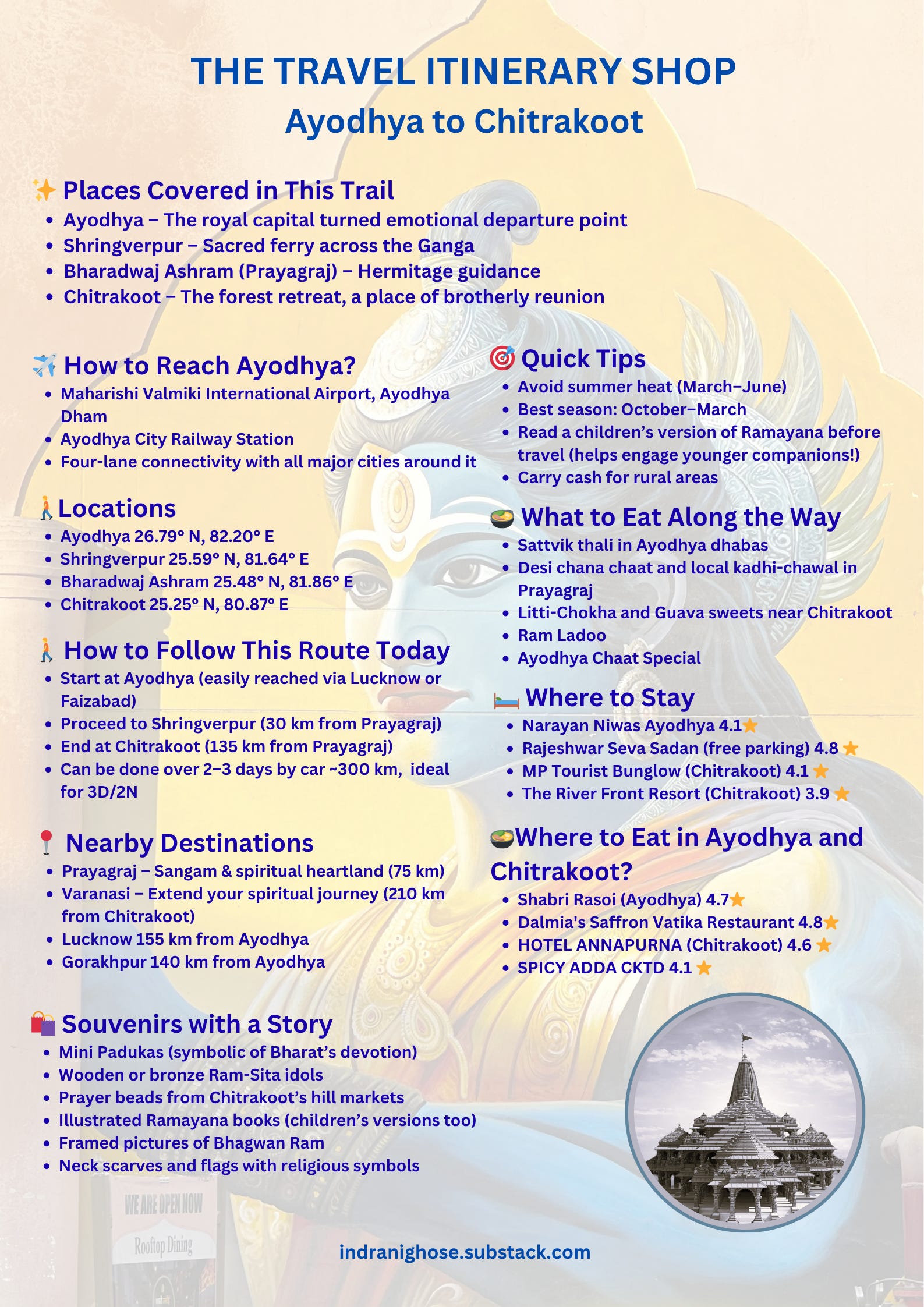
In the next issue, we’ll travel deeper into the forested paths—towards Dandakaranya, Panchavati, and eventually to the turning point of the epic: Sitaharan.
Have you been on any holy trail? I'd love to hear about your journey or answer questions if you're planning a visit. Share your thoughts in the comments below!
Happy Travels,
Indrani.
Do connect with me at:
Blog – i Share
Twitter - www.twitter.com/IndraniTweeets
Facebook - www.facebook.com/MyOnwardJourney
Instagram - www.instagram.com/indranipics
Pinterest - https://in.pinterest.com/indranighose/
YouTube - www.youtube.com/c/IndraniGhose
BlueSky - https://bsky.app/profile/indranighose.bsky.social
Very well articulated...
I can only imagine the anguish of Ram, stepping into an uncharted terrain.